


Table of Contents
- The Large Language Model (The Brain)
- Agentic AI (The Hands)
- RAG - Retrieval-Augmented Generation (The Safety Net)
- Create technology-free zones:
- Practice active listening:
- Use AI insights to personalize conversations:
- Deliberate patient interaction:
- For Individual Technicians
- For Pharmacy Leadership
- For Professional Organizations
- Algorithmic Bias
- Data Integrity Issues
- Privacy Violations
- Clinical Appropriateness Gaps
- Taking Action as an Auditor
- Pharm Tech Important Link Bank:
- FAQs
There's a silent anxiety running through our dispensaries and hospital pharmacies. You see it in the headlines about AI in pharmacy practice and the rapid rise of AI in pharmacy, as well as in the quiet conversations between shifts. The question is always the same, even if it's unspoken: "Will this technology make me obsolete?"
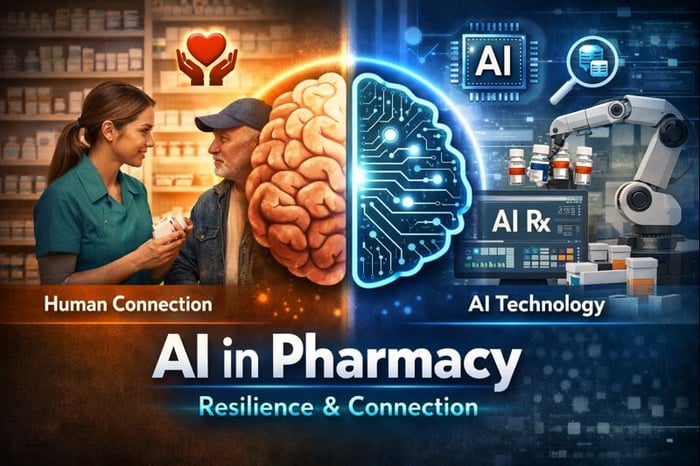
It's a valid fear. We're watching algorithms pass licensing exams, robots dispense medications with near-perfect accuracy, and AI systems flag drug interactions faster than any human could. But here's the truth that fear obscures: The future of pharmacy isn't "AI vs. Humans." It’s humans who use AI in pharmacy practice replacing humans who don’t.
Building pharmacy technician resilience means mastering the technology reshaping our profession while fiercely protecting the human connection that defines quality pharmaceutical care.
Here's how we do both.
Kill the Anxiety with Knowledge
Anxiety thrives in ignorance. The moment you understand how AI systems work, they stop looking like mysterious forces and start looking like tools you can control. To build pharmacy technician resilience through AI in pharmacy practice, you need to understand three core technical layers:
The Large Language Model (The Brain)
When you use AI to summarize a patient's medical history, understand what you're working with. An LLM doesn't "know" medicine; it knows the probability of which word comes next based on patterns in training data. It's prediction, not comprehension.
This matters because AI can "hallucinate" generating information that sounds correct but is clinically dangerous. A system might confidently state a dosage that's linguistically plausible but medically fatal. You are the clinical validator. Never accept AI output without verification against your actual drug database.
Agentic AI (The Hands)
We're moving from passive chatbots to active agents. An AI Agent doesn't just flag a drug interaction it can independently contact a prescriber, suggest alternatives based on your formulary, and document the intervention. These systems act autonomously.
You are the systems supervisor. Your role shifts from doing every task manually to overseeing systems that act independently, intervening when clinical judgment is required.
RAG - Retrieval-Augmented Generation (The Safety Net)
RAG forces AI to consult specific, verified databases like your pharmacy's actual formulary or latest FDA warnings before generating responses. Without RAG, you're getting educated guesses. With RAG, you're getting evidence-based information.
You are the quality controller. Always ask: "Is this AI pulling from verified sources, or improvising?"
The Industrial Analogy: From Weaver to Operator
History offers perspective. In the 1780s, the power loom terrified hand-loom weavers highly skilled artisans who'd spent years mastering their craft. When mechanical looms appeared, they seemed like an existential threat.
But the skill didn't die. It shifted. The weaver became a loom operator, overseeing ten machines instead of working one manually. The job changed from pure execution to systems management, quality control, and process optimization. Those who adapted thrived.
In pharmacy, we're experiencing the same transition:
- The Hand-Loom Era: Manually counting tablets, wrestling with insurance codes, spending hours on prior authorization calls
- The Power Loom Era: AI handles medication verification in milliseconds. Robots count with zero errors. Automated systems process claims overnight.
- Your New Role: You're not "counting pills." You're the Clinical Operator managing systems that ensure the right patient gets the right therapy, intervening with human judgment when required.
The technician who resists AI in pharmacy practice is the hand-loom weaver clinging to obsolete methods. The technician who embraces it becomes the master operator.
The Human Moat: What AI Cannot Do
Empathy cannot be coded. An AI can list chemotherapy side effects, but it cannot hold a patient's hand, look them in the eye, and give them courage to start treatment. It cannot de-escalate a frustrated father at the counter or sense unspoken fear in a teenager's voice.
That human connection in healthcare is your competitive advantage. But there's a warning: As we adopt these tools, we risk screen addiction. If you spend your entire shift staring at monitors, you're training yourself to be robot-like. You're atrophying the social skills that make you irreplaceable.
Practical Strategies for Maintaining Human Connection
Create technology-free zones:
Designate your counseling area as a space where you close the laptop and give full attention to the patient.
Practice active listening:
When a patient talks, listen to understand, not to formulate your response. Notice body language, tone, and what they're not saying.
Use AI insights to personalize conversations:
Let AI do the homework, pull interaction history, identify patterns then use that information for targeted, meaningful conversations. "I noticed you've had trouble with your evening dose. What if we..."
Deliberate patient interaction:
Don't let efficiency metrics override connection. A worried patient picking up their first psychiatric medication needs reassurance from a human voice, not just an information printout.
In a world of automated text messages, a genuine human voice is a luxury service. Provide it.
Building Resilient Communities: You Cannot Do This Alone
The "lone wolf" technician will not survive this transition. AI in pharmacy practice requires collective action. We need Learning Circles within our communities.
For Individual Technicians
- Commit to continuous learning: Dedicate two hours weekly to understanding AI tools. Subscribe to pharmacy technology resources. Experiment with new systems before they're mandated.
- Share knowledge aggressively: If you find a prompt that improves patient counseling, share it. Build a community library of effective pharmacy-specific prompts.
- Develop T-shaped skills:
- Vertical bar: Deep expertise in one area (clinical specialty, specific technology, patient population)
- Horizontal bar: Broad understanding of pharmacy operations, AI capabilities, human psychology
This combination makes you uniquely valuable.
Build your resilience toolkit:
- Physical: Exercise, sleep, sustainable nutrition
- Mental: Mindfulness practices, stress management, work-life boundaries
- Professional: Mentorship relationships, peer networks, continuing education
For Pharmacy Leadership
- Invest in comprehensive training: Don't just train on how to use systems explain why they work and where they fail. Budget 5-7% of technology investment for ongoing training, not just initial rollout.
- Create feedback loops: Regular check-ins during technology implementation. Anonymous reporting for AI errors. Act on feedback quickly ignored input destroys morale.
- Recognize both technical and interpersonal excellence: Don't reward only efficiency metrics. Also reward patient satisfaction, mentorship, innovation, and emotional intelligence.
- Foster psychological safety: Make it safe to say "I don't understand this system." Encourage healthy skepticism of AI outputs. Support staff who catch AI errors.
For Professional Organizations
- Develop AI literacy standards: What should every technician know about AI by 2027? Create accessible certification programs and competency assessments.
- Advocate for technician involvement in technology decisions: Technicians should be at the table when hospitals and chains select new systems. Your workflow expertise is invaluable demand a voice.
- Build global learning networks: Connect technicians across borders. A technician in rural India might have insights that help someone in urban America.
The Power Move: Becoming the AI Auditor
Don't wait for regulations. Don't accept technology implementations without question. Position yourself as an AI Auditor*the clinical and ethical checkpoint ensuring technology serves patients, not just efficiency metrics.
As an Auditor, watch for these critical red flags:
Algorithmic Bias
AI systems learn from historical data, perpetuating historical inequities. Watch for:
- Different medication recommendations based on patient zip codes (proxy for race/income)
- Varied counseling depth for patients with non-English names
- Prior authorization approval rates varying by insurance type beyond clinical necessity
Example: An AI trained on data from a health system that historically undertreated pain in certain populations might learn to recommend lower analgesic doses inappropriately. A vigilant technician notices the pattern and raises the alarm.
Data Integrity Issues
AI is only as good as its data sources. Watch for:
- Recommendations based on outdated drug databases
- Interaction warnings not reflecting recent FDA updates
- Systems pulling from multiple databases with conflicting information
Example: A new drug approved in late 2025, but your AI references a 2024 database. It flags an interaction only relevant to the previous formulation. Without verification, appropriate therapy is denied.
Privacy Violations
More sophisticated AI requires more data, creating privacy risks. Watch for:
- Patient information used to "improve" AI models without consent
- Data shared with third parties under vague "quality improvement" justifications
- stems that can identify patients even when supposedly de-identified
Example: Your AI counseling tool generates excellent talking points. Later, you discover the vendor uses patient conversations to train models sold to insurance companies for "adherence prediction." Patients never consented.
Clinical Appropriateness Gaps
Sometimes AI is technically correct but clinically inappropriate. Watch for:
- Recommending the "best" medication a patient cannot afford
- Suggesting complex regimens to patients with documented cognitive impairment
- Optimizing for clinical outcomes without considering quality of life
Example: AI recommends a four-times-daily medication that's 2% more effective than a once-daily alternative. For your 80-year-old patient with moderate dementia, the "better" medication is worse they'll never take it correctly.
Taking Action as an Auditor
When you identify problems:
- Document systematically: Date, time, case details, AI recommendation, correct action, potential harm
- Report through proper channels: Quality improvement systems, vendor error reporting, professional organizations, regulatory bodies when appropriate
- Advocate for systemic fixes: Don't just correct individual errors push for underlying algorithm updates
- Share learnings: Help other technicians watch for similar issues. Build collective AI skepticism.
If we don't take a seat at the table where these rules are written, we will be on the menu.
Global Perspectives: Learning Across Borders
AI in pharmacy practice looks different across contexts, but shared principles emerge:
- High-resource settings (North America, Europe, Japan): The challenge is preventing over-reliance. Sweden mandates face-to-face counseling for certain drug classes despite AI availability. Japan combines ubiquitous automation with strong cultural emphasis on patient-technician relationships.
- Resource-limited settings (parts of Africa, Latin America, rural Asia): Creative solutions with limited technology. Kenyan technicians use WhatsApp-based AI assistants for drug information. Indian community pharmacies use simple translation apps with human verification follow-up.
- Hybrid models (Singapore, Netherlands, Canada): Singapore uses centralized AI for clinical decision support while individual pharmacies maintain relationship-based care. Netherlands employs "clinical technology coordinators" senior technicians managing AI systems and training others.
Universal principles across all settings:
- Continuous learning culture
- Strong peer networks
- Patient-centered values
- Professional pride
- Advocacy mindset
The Path Forward: Skills for the Future
The pharmacy technician thriving in 2030 will have evolved capabilities:
- Technical literacy: Comfortable with AI systems, able to troubleshoot basic issues, understands limitations and failure modes
- Clinical reasoning: Can independently assess when to trust AI recommendations and when to question them
- Emotional intelligence: Expert at reading patients, building trust, de-escalating conflict, providing comfort
- Systems thinking: Understands how workflow changes affect the entire system
- Advocacy skills: Comfortable speaking up when AI recommendations are inappropriate or policies harm patients
- Continuous learning: Treats professional development as ongoing practice, not one-time achievement
Conclusion: The Goal Is Not to Outwork the AI
The goal is to be more human than the AI.
Let AI handle medication verification, insurance claims, and inventory predictions. You focus on what requires genuine human intelligence: the worried mother who needs reassurance, the complex patient requiring therapy optimization, the system producing biased recommendations that need challenging.
AI in pharmacy practice and the broader evolution of AI in pharmacy isn't replacing pharmacy technicians.It's freeing us to do work that actually requires human judgment and compassion.
The technicians who struggle will be those defining their value by automatable tasks. The technicians who thrive will embrace the full scope of what humans do better than machines: connect, empathize, reason through complexity, and advocate.
Your Next Steps
Today: Identify one AI system you don't fully understand. Spend 30 minutes learning how it works and where it fails.
This week: Share one
This month: Organize a meetup with other technicians to discuss AI in pharmacy practice and human connection. Identify one way your pharmacy's technology could be better implemented. Speak up.
This year: Develop deep expertise combining technical and clinical skills. Mentor someone struggling with the transition. Advocate for one policy change protecting human connection.
The pharmacy profession has survived countless technological revolutions from apothecaries hand-grinding herbs to automated compounding, from handwritten prescriptions to electronic records. We didn't just survive. We emerged stronger and more essential to healthcare.
This AI revolution is no different. We will adapt. We will evolve. We will become more valuable. But only if we choose to be architects of this change, not just witnesses.
Build your knowledge. Protect your humanity. Support your community. Speak up for your profession.
The future of AI in pharmacy practice starts with you, today. Back to work.
Pharm Tech Important Link Bank:
Here are a few helpful resources to support your pharmacy technician career:
🔗 Free CEUs for Pharmacy Technicians
https://www.pharmtechsonly.com/resource-center/free-ceus/
🔗 Search Upcoming Conventions in Your Area
https://www.pharmtechsonly.com/resource-center/conventions/
🔗 Rx Study Buddy Kit (Top 200, Math, Law)
https://www.pharmtechsonly.com/store/
FAQs
What is AI in pharmacy practice?
AI in pharmacy practice refers to the use of artificial intelligence to support medication verification, drug interaction screening, workflow automation, and clinical decision-making. These tools are designed to assist pharmacy professionals, not replace them, by improving accuracy, efficiency, and patient safety.
Will AI replace pharmacy technicians?
No. AI is changing pharmacy roles, but it is not replacing pharmacy technicians. Instead, technicians who learn to work with AI systems are becoming more valuable by focusing on clinical judgment, patient communication, and system oversight—areas where human skills remain essential.
How can pharmacy technicians build resilience in an AI-driven workplace?
Technicians can build resilience by:
Learning how AI tools work and their limitations
Continuing professional education and skill development
Strengthening emotional intelligence and patient communication
Participating in professional communities and peer learning
These steps help technicians adapt confidently to technological change.
What risks does AI create in pharmacy settings?
Potential risks include:
Incorrect or “hallucinated” clinical information
Algorithmic bias affecting patient care
Outdated or inaccurate data sources
Patient privacy and data security concerns
This is why human verification and oversight remain critical in AI-supported pharmacy workflows.