 Faruq Niniola•May 13th, 2026•8 minute read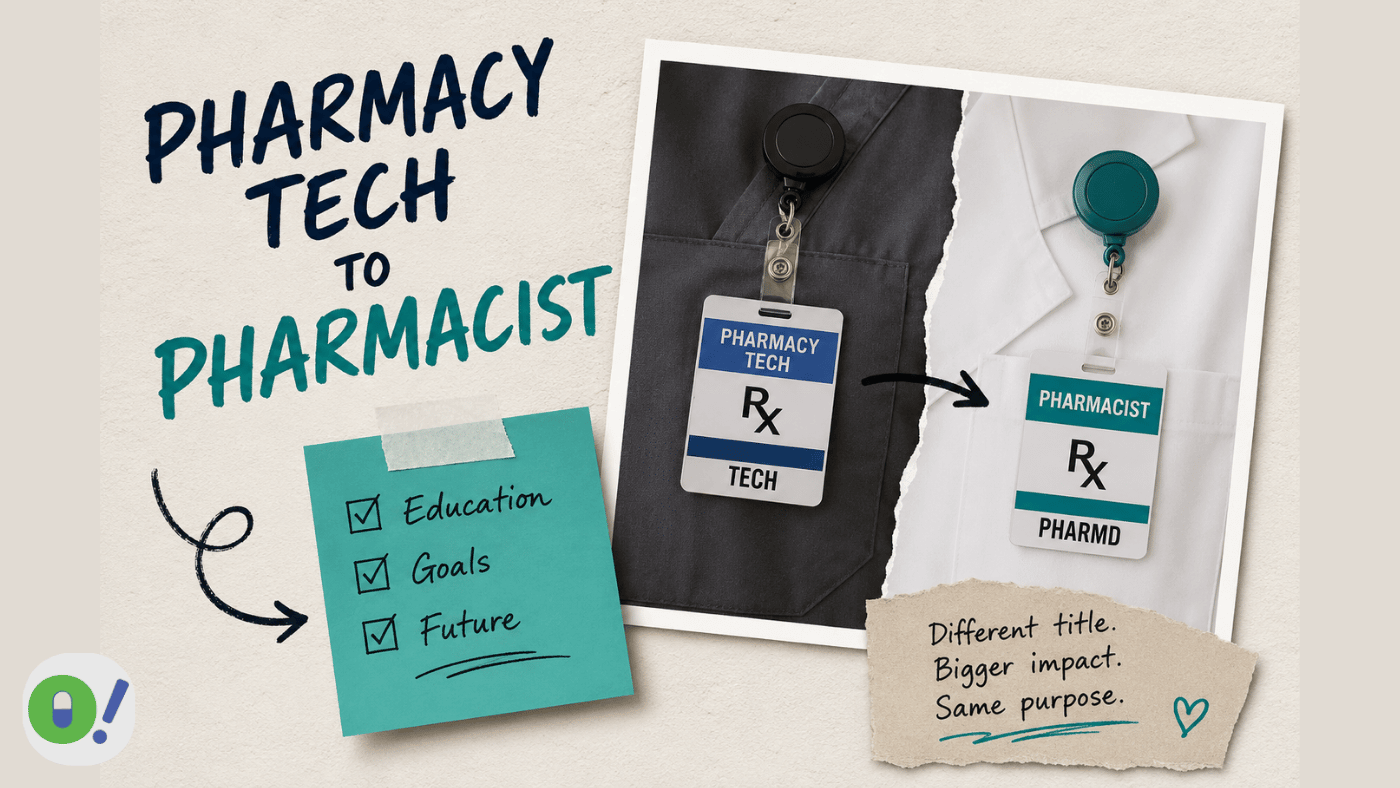
Table of Contents
If you’re thinking aboutgoing from pharmacy tech to pharmacist, you’re not alone.
Many pharmacy technicians eventually start wondering if the pharmacy tech to pharmacist path may be the right next step in their healthcare career.
Maybe it happens during a stressful shift, while helping solve insurance issues, or while watching a pharmacist make decisions you already partially understand from years of pharmacy experience.
For many techs, the idea starts quietly, then slowly grows into something bigger:
- Wanting more responsibility
- Wanting higher pay
- Wanting more stability
- Wanting a stronger voice in patient care
- Wanting long-term career growth
And the truth is:
Yes, a pharmacy tech can become a pharmacist.
In fact, many pharmacists started their careers as pharmacy technicians.
But the path from pharmacy tech to pharmacist can feel confusing, expensive, and overwhelming if nobody explains it clearly. This guide breaks it down in a realistic, honest way so you can better understand what the journey actually looks like.
Why Pharmacy Technicians Consider Becoming Pharmacists
For many healthcare workers, the pharmacy tech to pharmacist path feels like a natural progression after years of pharmacy experience.
Working as a pharmacy technician gives you a unique view of healthcare.
You already understand:
- Prescription processing
- Insurance rejections
- Medication names
- Pharmacy workflow
- Customer and patient interactions
- Prior authorizations
- Inventory systems
- Medication safety basics
You see firsthand how pharmacies operate every day.
Eventually, many techs start realizing they may be capable of more professionally.
Some want better pay.
Some want greater respect within healthcare.
Some want more clinical involvement.
Others simply want to continue growing instead of feeling stuck in the same role year after year.
Whatever your reason is, it matters.
But before starting the process, it’s important to understand what becoming a pharmacist actually involves.
Pharmacy Technician vs Pharmacist: What’s the Difference?
Many people outside of pharmacy assume pharmacy technicians and pharmacists do nearly the same job.
But professionally and legally, the roles are very different.
Pharmacy Technicians Typically:
- Process prescriptions
- Enter patient information
- Handle insurance claims
- Count and prepare medications
- Assist customers
- Manage inventory
- Support pharmacy workflow
Pharmacists Typically:
- Verify prescriptions
- Make clinical decisions
- Counsel patients
- Monitor drug interactions
- Adjust medication therapy
- Ensure medication safety
- Take legal responsibility for prescriptions
- Administer vaccines (depending on laws and settings)
The biggest difference is this:
Pharmacy technicians support the process. Pharmacists make the final clinical decisions.
That shift in responsibility is significant.
And it requires far more education, training, and accountability.
Step 1: Understand Why You Want to Become a Pharmacist
Before researching schools or pharmacy programs, ask yourself something important:
Why do you want this?
Your answer matters more than you think.
Because pharmacy school is challenging.
You may face:
- Financial stress
- Long study hours
- Student loans
- Mental exhaustion
- Balancing work and school
- Difficult exams
- Lifestyle changes
If your only motivation is frustration with your current job, that feeling may eventually fade.
But if your motivation is growth, ambition, purpose, or wanting a larger role in patient care, those reasons tend to carry people through difficult moments.
Be honest with yourself.
You do not need a perfect reason.
But you do need a meaningful one.
Step 2: Educational Requirements for the Pharmacy Tech to Pharmacist Path
The pharmacy tech to pharmacist path usually involves multiple stages.
Most Pharmacists Need:
- College prerequisite courses
- Acceptance into a PharmD program
- Completion of pharmacy school
- Licensing exams
- State licensure
In the United States, pharmacists typically earn a Doctor of Pharmacy (PharmD) degree.
Most pharmacy schools require prerequisite college courses before applying.
These commonly include:
- Biology
- Chemistry
- Organic chemistry
- Anatomy and physiology
- Microbiology
- Statistics
- Algebra or calculus
- English composition
Some students complete a bachelor’s degree before pharmacy school.
Others apply after finishing only the required prerequisites.
Every pharmacy school is slightly different, so always research individual program requirements carefully.
Step 3: Research Pharmacy Schools Carefully
Not every pharmacy school fits every student.
Some programs are:
- Traditional full-time programs
- Accelerated programs
- Hybrid programs
- Transfer-friendly programs
- Programs designed for working adults
As a pharmacy technician, you should look for schools that:
- Value pharmacy experience
- Offer flexibility
- Provide strong clinical rotations
- Have good graduate outcomes
- Offer financial aid support
- Have strong NAPLEX pass rates
Many pharmacy technicians continue working part-time while attending pharmacy school.
Your real-world pharmacy experience can actually become a major advantage once classes begin.
Programs such as those offered by University of Cincinnati may also be worth researching if you are exploring flexible healthcare education options.
Sponsored Feature

From Pharmacy Technician to Leadership
Pharmacy technicians have a wide range of paths ahead of them. The University of Cincinnati's online MS in Pharmacy Leadership helps professionals build the skills they need to step into supervisor and management roles.
Designed for working professionals, this flexible program through UC Online focuses on leadership, operations, and healthcare strategy through a pharmacy lens.
👉Explore the program's details online.
Step 4: Understand the Financial Commitment
This is the part many people avoid talking about.
Pharmacy school can be expensive.
Depending on the school, total tuition may range from tens of thousands to well over $100,000.
You also need to consider:
- Living expenses
- Reduced work hours
- Transportation
- Books and supplies
- Licensing exam fees
Before committing, create a realistic financial plan.
Ask yourself:
- Will I work during school?
- Will I need student loans?
- Can I reduce expenses temporarily?
- Do I have family support?
- Will this investment improve my long-term future?
For many people, the answer is yes.
But it’s important to enter the process fully informed.
Step 5: Use Your Pharmacy Technician Experience as an Advantage
This is something many future pharmacy students underestimate:
Your pharmacy technician experience matters.
A lot.
You already understand concepts that completely overwhelm brand-new pharmacy students.
You know:
- SIG codes
- Prescription workflow
- Insurance troubleshooting
- Medication names
- Brand vs generic drugs
- Pharmacy software systems
- Real pharmacy stress
That experience creates a huge advantage.
While some students are learning basic pharmacy operations for the first time, you are connecting classroom concepts to real-world situations you have already experienced.
Do not underestimate how valuable that background can be.
Step 6: Prepare for Mental and Emotional Challenges
Becoming a pharmacist is not just academically difficult.
It can also be emotionally exhausting.
There may be times when you feel:
- Overwhelmed
- Burned out
- Financially stressed
- Mentally drained
- Unsure of yourself
This is normal.
Almost every pharmacy student experiences moments of doubt.
The important thing is understanding that growth rarely feels comfortable while it’s happening.
There will also be moments where:
- Concepts finally click
- You realize how much you’ve learned
- You become more confident clinically
- You start thinking like a pharmacist
Those moments matter too.
Step 7: Stop Waiting to Feel “Ready”
One of the biggest reasons people delay becoming a pharmacist is waiting for the “perfect time.”
But most people never feel fully ready.
Not financially.
Not mentally.
Not academically.
If you wait until everything feels perfectly aligned, you might delay yourself for years.
Instead:
- Research schools
- Speak with admissions advisors
- Connect with pharmacists
- Shadow different pharmacy settings
- Take one prerequisite course
- Start small if needed
Confidence often comes after taking action, not before.
Alternative Career Paths for Pharmacy Technicians
It is also okay if you realize pharmacy school may not be the right fit for you.
Many pharmacy technicians successfully transition into other careers, including:
- Healthcare administration
- Medical coding
- Prior authorization specialist roles
- Clinical research
- Pharmaceutical sales
- Pharmacy informatics
- Healthcare IT
- Data analysis
- Regulatory affairs
Career growth does not only happen through becoming a pharmacist.
The important thing is continuing to build a future that aligns with your goals and lifestyle.
Is Becoming a Pharmacist Worth It?
This answer depends entirely on your personal goals.
For some people, absolutely yes.
For others, maybe not.
The pharmacy profession has changed significantly over the years.
Some pharmacists experience:
- Heavy workloads
- Staffing shortages
- Retail burnout
- High stress
- Pressure from metrics
But many pharmacists also find fulfillment through:
- Patient care
- Hospital pharmacy
- Oncology pharmacy
- Ambulatory care
- Clinical specialties
- Teaching
- Leadership
- Informatics
Before committing, research the profession honestly.
Talk to pharmacists working in different settings.
Ask real questions.
Understand both the positives and challenges.
Final Thoughts on Going From Pharmacy Tech to Pharmacist
There is absolutely nothing wrong with being a pharmacy technician.
Pharmacy technicians are essential to healthcare.
But if you feel pulled toward something more, that feeling deserves attention.
The pharmacy tech to pharmacist journey is not easy, but for many technicians, it can lead to significant professional growth.
And many people who once stood exactly where you are now eventually made it happen.
You do not need to have everything figured out today.
You simply need to be willing to explore what could be next.
Continue Growing Your Pharmacy Career
At Pharm Techs Only!, we support pharmacy technicians worldwide through:
- Career resources
- Pharmacy technician jobs
- Professional networking
- Industry discussions
- Career growth content
- Free CE opportunities
You can also explore:
We Want to Hear From You
If you are currently a pharmacy technician thinking about becoming a pharmacist:
What is the biggest thing holding you back right now?
- Time?
- Money?
- Confidence?
- Family responsibilities?
- Burnout?
Or if you have already started the process:
What do you wish you knew before beginning pharmacy school?
Share your thoughts and experiences in the comments to help support other pharmacy technicians considering the next step in their careers
Pharm Tech Important Link Bank:
Here are a few helpful resources to support your pharmacy technician career:
🔗 Free CEUs for Pharmacy Technicians
https://www.pharmtechsonly.com/resource-center/free-ceus/
🔗 Search Upcoming Conventions in Your Area
https://www.pharmtechsonly.com/resource-center/conventions/
🔗 Rx Study Buddy Kit (Top 200, Math, Law)
https://www.pharmtechsonly.com/store/
🔗 Search Pharmacy Technician Jobs
https://tc.pharmtechsonly.com/careers
FAQs
Can a pharmacy tech become a pharmacist?
Yes. Many pharmacists started their careers as pharmacy technicians. The pharmacy tech to pharmacist path typically involves completing prerequisite college courses, attending pharmacy school, earning a PharmD degree, and passing licensing exams.
How long does it take to go from pharmacy tech to pharmacist?
The timeline varies depending on your education background and whether you attend school full-time or part-time. Most pharmacy tech to pharmacist journeys take several years, including prerequisite courses and pharmacy school.
Do pharmacy technicians have an advantage in pharmacy school?
Yes. Pharmacy technicians often already understand prescription workflow, insurance processing, medication names, pharmacy software, and patient interactions. This real-world experience can help during pharmacy school.
Is becoming a pharmacist worth it financially?
For some people, yes. Pharmacists generally earn significantly more than pharmacy technicians, but pharmacy school can also involve major financial commitments, including tuition, books, and student loans. It’s important to research costs carefully before starting the pharmacy tech to pharmacist path.
What if I decide pharmacy school is not right for me?
Advance Your Pharmacy Technician Career
Access 100% free accredited CEUs, salary benchmarks, and connect with 26,000+ peers.
Faruq Niniola
Founder & AdvocateCourtney has over 30 years of frontline experience as a certified pharmacy technician across retail, hospital, and leadership settings. She founded Pharm Techs Only! to empower, elevate, and support pharmacy technicians worldwide.
Learn more about our mission →