


 Faruq Niniola•August 7th, 2025•10 minute read min read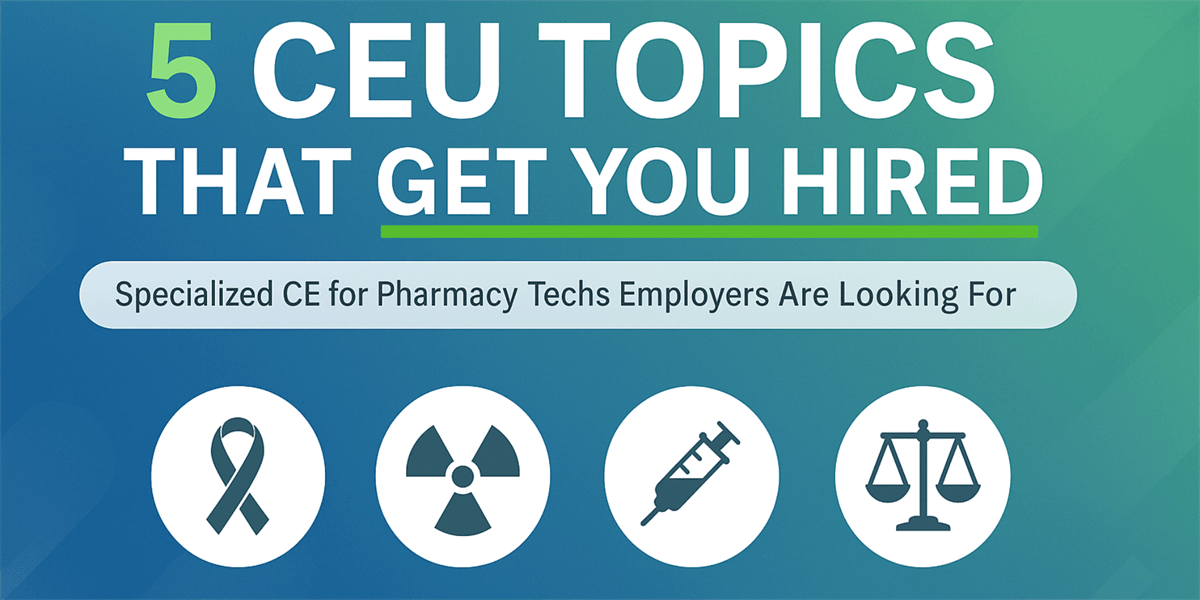
Table of Contents
- Why Specialized Pharmacy Technician CEUs Matter
- Why It Matters
- What You May Learn
- Career Impact
- Where to Start
- Why It Matters
- What You May Learn
- Career Impact
- Where to Start
- Why It Matters
- What You May Learn
- Career Impact
- Where to Start
- Why It Matters
- What You May Learn
- Career Impact
- Where to Start
- Why It Matters
- What You May Learn
- Career Impact
- Where to Start
- 1. Where Do I Want My Career to Go?
- 2. Does the CE Match My Current or Future Role?
- 3. Is the Course Recognized or Appropriate for My Requirement?
- Pharm Tech Important Link Bank:
- FAQs
Why Specialized Pharmacy Technician CEUs Matter
Pharmacy technician CEUs are more than a requirement for maintaining a credential. When chosen strategically, continuing education can help technicians develop specialized knowledge, strengthen their resumes, and prepare for roles that require skills beyond routine pharmacy operations.
The pharmacy profession continues to evolve. Technicians may work in community pharmacies, hospitals, specialty pharmacies, compounding facilities, medication management programs, mail-order operations, and other healthcare environments.
That means your continuing education does not have to be random.
Instead of simply completing CE hours to meet a renewal requirement, you can choose pharmacy technician CEUs that align with the type of work you want to do next.
Interested in sterile compounding? Choose CE focused on compounding and medication safety.
Interested in specialty pharmacy? Explore education related to oncology or hazardous drug management.
Interested in more patient-focused responsibilities? Medication history or medication therapy management education may be worth exploring.
At Pharm Techs Only!, we want to make that process easier. Our Free CEU Listing Page helps pharmacy technicians find continuing education opportunities, while our job board connects technicians with career opportunities.
Here are five specialized areas worth considering.
1. Oncology Pharmacy and Hazardous Drug Management
Why It Matters
Oncology pharmacy involves medications that require careful handling, preparation, storage, administration support, and disposal. Some cancer medications are classified as hazardous drugs and require appropriate precautions to reduce occupational exposure.
USP <800> addresses the handling of hazardous drugs in healthcare settings, including receiving, storage, preparation, dispensing, administration, and disposal. Pharmacy technicians are among the healthcare professionals who may be exposed to hazardous drugs if appropriate precautions are not followed.
That makes education in hazardous drug management particularly relevant for technicians interested in oncology and specialty pharmacy.
What You May Learn
Specialized CE may cover topics such as:
Hazardous drug identification
Personal protective equipment
Safe handling and transportation
Decontamination and cleaning
Hazardous drug waste and disposal
Spill management
Engineering controls
Safe compounding practices
Medication safety in oncology
Career Impact
Oncology-focused education can help demonstrate your interest in specialized pharmacy practice.
It may be particularly relevant when pursuing opportunities in:
Hospital pharmacies
Cancer centers
Oncology departments
Specialty pharmacies
Infusion-related settings
Compounding environments
However, remember that CE completion does not automatically qualify you for a specialized position or guarantee higher pay. Employers may also require specific training, experience, certification, or other qualifications.
Where to Start
Look for accredited education in hazardous drug management, oncology pharmacy, and sterile compounding. PTCB currently offers a Hazardous Drug Management Certificate among its advanced certificate options.
2. Nuclear Pharmacy and Radiopharmaceuticals
Why It Matters
Nuclear pharmacy is one of the more specialized areas of pharmacy practice.
Radiopharmaceuticals are radioactive drugs used in nuclear medicine for diagnostic imaging and, in some cases, treatment. Because radioactive materials require specialized handling and regulatory controls, this area demands additional knowledge beyond general pharmacy practice.
For a pharmacy technician interested in a highly specialized career path, nuclear pharmacy education can be an interesting addition to a professional development plan.
What You May Learn
Depending on the course, nuclear pharmacy CE may address:
Radiation safety
Radiopharmaceutical handling
Radioactive material safety
Quality control
Contamination prevention
Radiation protection principles
Regulatory requirements
Specialized equipment and procedures
Career Impact
Nuclear pharmacy education can demonstrate that you are willing to develop expertise in a technically demanding area.
Potential work environments may include:
Nuclear pharmacies
Hospitals with nuclear medicine departments
Diagnostic imaging environments
Academic medical centers
Specialized radiopharmaceutical facilities
However, requirements vary by role and jurisdiction. Education alone does not authorize a technician to handle radioactive materials or perform duties restricted by law or institutional policy.
Where to Start
Nuclear pharmacy education can be more difficult to find than general pharmacy technician CE. Look for reputable providers with appropriate accreditation and content relevant to your role and jurisdiction.
3. Sterile Compounding and USP <797>
Why It Matters
Sterile compounding is one of the strongest areas for pharmacy technicians who want to move into hospital, infusion, specialty pharmacy, or compounding roles.
Compounded sterile preparations require specialized knowledge and skills because contamination or preparation errors can create serious risks for patients.
PTCB describes sterile compounding as an area requiring knowledge and skills beyond the standard CPhT level. Its Certified Compounded Sterile Preparation Technician (CSPT) credential is specifically designed to demonstrate advanced sterile preparation expertise.
What You May Learn
Sterile compounding CEUs may cover:
Aseptic technique
Hand hygiene
Personal protective equipment
Cleanroom behavior
Garbing procedures
Primary engineering controls
Cleaning and disinfection
Environmental monitoring
Beyond-use dating
Sterile preparation procedures
Hazardous and non-hazardous compounded sterile preparations
Career Impact
Sterile compounding education can strengthen your preparation for positions in:
Hospital pharmacies
Home infusion
Specialty pharmacies
Compounding facilities
Outpatient infusion settings
If you want to pursue advanced sterile compounding credentials, make sure you understand the eligibility requirements. For example, PTCB's current CSPT pathway requires an active PTCB CPhT plus specified education and experience, or an alternative experience pathway.
So, think of CE as part of a larger professional development plan—not a replacement for required experience or certification.
Where to Start
Search for accredited sterile compounding CEUs and education aligned with current USP <797> requirements and your employer's procedures.
4. Medication Therapy Management
Why It Matters
Medication Therapy Management (MTM) is another area worth exploring if you are interested in patient-focused pharmacy services.
Technicians can support medication management activities in defined roles and under appropriate supervision, depending on the practice setting and applicable laws and policies.
PTCB currently offers a Medication Therapy Management Certificate designed for active CPhTs who complete a PTCB-recognized MTM education/training program.
What You May Learn
MTM-related education may include:
Medication therapy management concepts
Medication histories
Medication reconciliation
Patient communication
Medication adherence
Documentation
Identifying potential medication-related problems
Supporting pharmacists with medication management services
Career Impact
This type of education may be particularly useful for technicians interested in:
Community pharmacy
Ambulatory care support
Medication management programs
Health plans
Telepharmacy
Patient-focused pharmacy services
It can also demonstrate that your interests extend beyond traditional dispensing functions.
Where to Start
If MTM interests you, consider recognized education programs and review your local scope-of-practice requirements before pursuing roles involving patient-care activities.
PTCB also offers a separate Medication History Certificate, with eligibility requirements that include an active CPhT and specified education and/or experience.
5. Pharmacy Law, Regulatory Compliance, and Ethics
Why It Matters
You do not have to work in a specialty pharmacy to benefit from specialized education.
Pharmacy law and regulatory compliance are valuable areas for technicians because pharmacies operate within extensive legal, regulatory, privacy, and safety requirements.
Technicians may encounter issues involving controlled substances, documentation, inventory management, patient confidentiality, fraud prevention, quality assurance, and other compliance responsibilities.
What You May Learn
Pharmacy law and compliance education may cover:
Controlled substance regulations
Prescription requirements
Patient privacy and confidentiality
Record keeping
Fraud, waste, and abuse
Diversion prevention
Inventory controls
Quality assurance
Regulatory compliance
Ethical decision-making
Career Impact
Compliance-focused education may be useful for technicians interested in:
Lead technician positions
Supervisory roles
Quality assurance
Pharmacy operations
Mail-order pharmacy
Specialty pharmacy
Regulatory or compliance-related work
PTCB currently offers a Regulatory Compliance Certificate covering areas such as patient safety and quality assurance strategies. It also offers a Controlled Substances Diversion Prevention Certificate.
Where to Start
Because pharmacy law varies by jurisdiction, prioritize education that is relevant to where you practice.
If your state requires law CE for renewal, make sure the course satisfies the applicable requirements rather than assuming that any law course will count.
How to Choose the Right Pharmacy Technician CEUs
With so many CE options available, it can be tempting to collect courses simply because they are free or interesting.
Instead, ask yourself three questions before choosing your next course.
1. Where Do I Want My Career to Go?
Think about your next position not just your current one.
Do you want to work in a hospital?
Consider sterile compounding.
Interested in specialty pharmacy?
Explore oncology or hazardous drug management.
Interested in patient-focused services?
Look into medication history or MTM.
Interested in leadership?
Regulatory compliance, operations, and management education may be useful.
2. Does the CE Match My Current or Future Role?
A CE course is most valuable when you can actually apply what you learn.
Look for education that connects with your responsibilities or the position you hope to obtain.
3. Is the Course Recognized or Appropriate for My Requirement?
Before enrolling, verify whether the provider and course meet your certification, registration, licensing, or employer requirements.
For technicians maintaining PTCB credentials, for example, CE requirements and recognized providers should be checked against current PTCB guidance.
Stack Your Pharmacy Technician CEUs Strategically
You do not necessarily have to choose just one area.
Strategic combinations can make your professional development more focused.
For example:
Sterile compounding + hazardous drug management
A strong combination for technicians interested in compounding and specialty pharmacy environments.
Medication history + medication therapy management
Useful for technicians interested in patient-focused medication services.
Regulatory compliance + controlled substance diversion prevention
Relevant to technicians interested in pharmacy operations, compliance, inventory control, or leadership.
The key is to build a learning path rather than simply collecting certificates.
Your CE should tell a story about where you want your career to go.
Don't Forget Your Career Opportunities
Completing specialized pharmacy technician CEUs is only one part of career development.
Once you have developed new skills, make sure employers can see them.
Update your:
Resume
LinkedIn profile
Professional certifications
Skills section
Professional portfolio
Job profiles
When appropriate, mention specialized training during interviews and explain how the knowledge could benefit the employer.
For example, don't simply say:
"I completed a sterile compounding CE course."
Explain what you learned and how it relates to the position:
"I recently completed additional education in sterile compounding and have been developing my knowledge of aseptic technique, cleanroom procedures, and medication safety."
That tells an employer much more.
And if you are ready for your next opportunity, explore pharmacy technician jobs and connect your new skills to positions that actually use them.
Final Thoughts: Make Your CEUs Work for You
Continuing education should not feel like a box you have to check every renewal cycle.
Your pharmacy technician CEUs can become part of your career strategy.
Whether you choose oncology, nuclear pharmacy, sterile compounding, medication therapy management, regulatory compliance, or another specialized area, the goal should be the same:
Learn something useful. Build relevant skills. Apply what you learn.
Remember, CEUs alone do not guarantee a promotion, a new position, or higher pay.
But targeted education can help you demonstrate initiative, build knowledge, and position yourself for opportunities that match your professional goals.
At Pharm Techs Only!, we're here to help you take that next step.
Use our Free CEU Listing Page to discover continuing education opportunities, then explore our Job Board for pharmacy technician career opportunities.
Your next career opportunity may start with the next course you choose.
Don't just complete your CEUs. Build your career with them.
Pharm Tech Important Link Bank:
Here are a few helpful resources to support your pharmacy technician career:
🔗 Free CEUs for Pharmacy Technicians
https://www.pharmtechsonly.com/resource-center/free-ceus/
🔗 Search Upcoming Conventions in Your Area
https://www.pharmtechsonly.com/resource-center/conventions/
🔗 Rx Study Buddy Kit (Top 200, Math, Law)
https://www.pharmtechsonly.com/store/
🔗 Search Pharmacy Technician Jobs
https://tc.pharmtechsonly.com/careers
FAQs
What are the best pharmacy technician CEUs for career advancement?
The best CEUs depend on your career goals. Sterile compounding, hazardous drug management, medication therapy management, medication history, regulatory compliance, and other specialized topics can be useful depending on the role you want to pursue
Can pharmacy technician CEUs help me get a better job?
Specialized CEUs can strengthen your knowledge and demonstrate professional development, but completing CEUs does not guarantee employment, promotion, or higher pay. Employers may also consider experience, certification, education, and other qualifications.
How many CEUs does a pharmacy technician need?
The number of CE hours required depends on the certification or license being maintained and the applicable jurisdiction or organization. Pharmacy technicians should check the current requirements of their certification body, state board, or employer.
Are sterile compounding CEUs useful for pharmacy technicians?
Yes. Sterile compounding education can be particularly relevant for technicians interested in hospital, home infusion, specialty pharmacy, or compounding roles. Additional certification or work experience may be required for specific positions.

