 Faruq Niniola•August 26th, 2026•15 minute read
Table of Contents
Have you outgrown your pharmacy technician job, or are you simply having a difficult week? That question can be surprisingly hard to answer, especially in pharmacy, where heavy workloads, staffing shortages, insurance problems, impatient customers, constant interruptions, and the pressure to avoid errors can make almost any shift feel exhausting.
There is an important difference, however, between temporarily feeling frustrated and realizing that your current position no longer supports your professional growth. You may still care deeply about pharmacy. You may still enjoy helping patients, solving medication problems, supporting your team, and working in healthcare. The issue may not be the pharmacy technician profession at all. The issue may be that your present role has stopped giving you room to grow.
Outgrowing a job is not a sign that you are ungrateful, disloyal, or incapable of handling pressure. Sometimes it means your experience has expanded while your position has remained exactly the same. Your responsibilities may have increased without an appropriate change in pay, title, autonomy, training, or opportunity.
Before making a sudden decision, it helps to identify what is actually wrong. Do you need a vacation, a conversation with management, a new responsibility, a different pharmacy setting or a completely new position?
This guide explores seven signs that you may have outgrown your pharmacy technician job, questions to ask yourself, and practical steps you can take before deciding what comes next.
1. You Are No Longer Learning Anything New
Most pharmacy technician positions involve repetition. Repetition itself is not necessarily a problem; it can build speed, accuracy, confidence, and sound judgment. The warning sign is when repetition becomes stagnation.
Perhaps you have mastered your pharmacy’s workflow, software, insurance processes, inventory procedures, and daily responsibilities. You are frequently the person coworkers approach with questions, yet no one is helping you develop the next level of skills. You are capable of more, but every day looks exactly like the day before it.
Professional growth does not have to mean receiving a promotion every year. It can include:
Learning sterile or nonsterile compounding
Training in medication reconciliation
Becoming more involved in inventory management or purchasing
Learning specialty pharmacy workflows
Participating in quality assurance or medication-safety projects
Becoming a trainer, mentor, lead technician, or supervisor
Developing expertise in prior authorizations or insurance resolution
Learning automation, data, informatics, or pharmacy technology systems
One of the clearest signs you have outgrown your pharmacy technician job is that you are ready to learn new skills, but your current position offers no access to them.
If you have repeatedly asked for training and continue to hear “maybe later,” pay attention. A workplace that depends on your current skills but will not help you develop new ones may be benefiting from keeping you exactly where you are.
Questions to Ask Yourself
What meaningful skill have I learned during the last year?
Is there anyone in this workplace who can mentor me?
Am I being prepared for my next role—or only scheduled for my next shift?
If I stay here for another two years, what will be different?
If you cannot identify a realistic opportunity to keep learning, you may have outgrown your pharmacy technician job even if you still perform it extremely well.
2. Your Responsibilities Have Grown, but Your Pay and Title Have Not
Many experienced pharmacy technicians gradually take on additional duties without a formal discussion. At first, being trusted with more responsibility can feel rewarding. Over time, however, “helping out” can turn into performing a higher-level role without the recognition or compensation that should accompany it.
You may be:
Training every new employee
Handling difficult insurance issues
Managing controlled-substance inventory
Creating schedules or assigning workflow
Solving problems when management is unavailable
Preparing for audits
Monitoring compliance tasks
Acting as the unofficial lead technician
Covering chronic staffing gaps
There is nothing wrong with demonstrating initiative. In fact, these responsibilities may strengthen your résumé. But when increased expectations become permanent while your title and pay remain unchanged, it is reasonable to question whether the arrangement is fair.
Document the duties you perform beyond your original job description. Include measurable results whenever possible: employees trained, inventory discrepancies reduced, workflow improvements introduced, audit preparation completed, or turnaround times improved. Then request a specific conversation about your role.
Do not limit the discussion to “I work hard.” Explain the value and level of responsibility you now provide. Ask whether your position can be reevaluated, whether a lead role exists, and what concrete requirements must be met for advancement.
If leadership acknowledges that you are performing higher-level work but offers no title, pay adjustment, development plan, or timeline, that is valuable information. Your experience may be more appreciated somewhere else.
When the level of work has changed but the employment terms never do, you may have outgrown your pharmacy technician job as it is currently defined.
3. There Is No Clear Path for Advancement
Some pharmacy workplaces have a visible career ladder: technician I, technician II, senior technician, lead technician, buyer, trainer, supervisor, operations specialist, or manager. Others have no defined progression at all.
A flat structure is not automatically negative. A technician may genuinely prefer a stable position without management responsibilities. But if you want pharmacy technician career growth and your employer cannot explain how advancement happens, you may eventually feel trapped.
Vague promises are not a career-development plan. Statements such as “keep doing what you’re doing,” “we’ll see what opens up,” or “your time will come” mean very little without qualifications, milestones, and a timeline.
Ask direct questions:
What position could I realistically advance into?
What skills, certification, or experience would I need?
Has another technician advanced through this path recently?
What timeline would be reasonable?
Can we create a written development plan?
The answers will help you determine whether an opportunity is real or merely theoretical.
If every possible next step exists only in theory, you may have outgrown your pharmacy technician job even though you have not outgrown the pharmacy profession.
You can also review the Pharm Techs Only! guide to creating a five-year pharmacy technician career plan. A career plan makes it easier to evaluate whether your current employer can support where you actually want to go.
4. You Are Staying Only Because Change Feels Risky
Familiarity can feel like security, even when you are unhappy. You know the pharmacy system, the patients, the personalities, the shortcuts, and the unwritten rules. Starting over means becoming the new person again, learning different procedures, and accepting uncertainty.
Those concerns are valid. A new job is not automatically a better job. Pay may be higher while the schedule is worse. A hospital position may sound exciting but require weekends, holidays, additional credentials, or a longer commute. A remote position may eliminate commuting but introduce isolation, productivity metrics, or multi-state licensing requirements.
The goal is not to leave simply because another position exists. The goal is to avoid allowing fear to make the decision for you.
Consider whether these thoughts sound familiar:
“At least I know what to expect here.”
“I would have to start at the bottom somewhere else.”
“Maybe no one else would hire me.”
“I’ve been here too long to leave now.”
“This is just how pharmacy is everywhere.”
Experience does not disappear when you change employers. Your knowledge of medications, insurance, pharmacy law, patient communication, inventory, workflow, and problem-solving travels with you. You may need to learn a new system, but you are not starting your career over from zero.
Recognizing that you have outgrown your pharmacy technician job does not erase the years you invested there. Those years created the experience you can now carry into a stronger opportunity.
You also do not have to resign in order to explore. Update your résumé, review job descriptions, speak with technicians in other settings, and submit a few carefully selected applications. Research can replace fear with actual information.
5. Your Strengths Are Being Underused
Pharmacy technicians do not all have the same talents. One may be exceptional at calming an angry patient. Another may enjoy calculations, compounding, insurance troubleshooting, inventory, technology, teaching, or organizing a chaotic workflow.
When your strongest abilities are rarely used, work can begin to feel dull or disconnected. You may be competent in your current role while knowing that you could contribute much more in a different one.
You may have outgrown your pharmacy technician job when the qualities that make you valuable are being underused instead of developed.
For example:
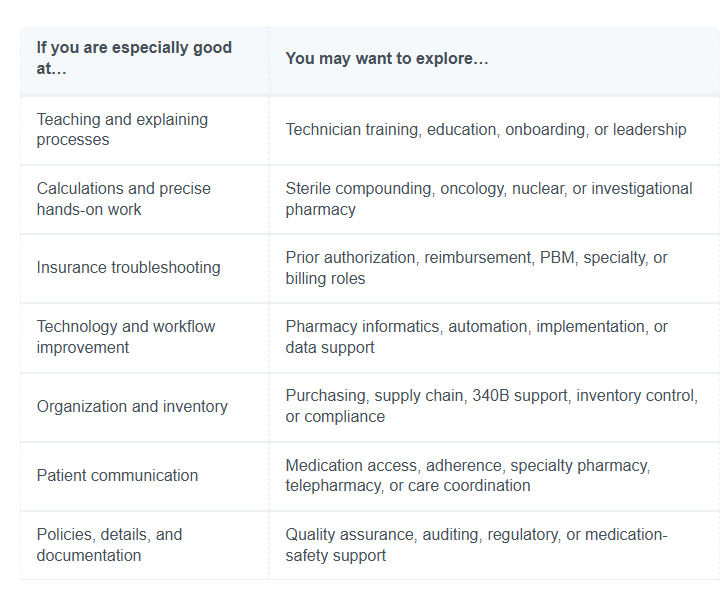
This table is not a promise that every role will be available in every location or that no additional qualifications will be needed. Licensing, certification, education, and scope of practice vary. It is a starting point for recognizing how your existing strengths could transfer.
If you are unsure what options exist, explore pharmacy technician career paths and compare them with the work you naturally enjoy.
6. The Workplace Is Damaging Your Well-Being
No job is stress-free, and pharmacy carries real pressure. Patient safety matters. Interruptions are constant. Workloads can change rapidly. A difficult day does not necessarily mean you need to leave.
But ongoing harm should not be normalized as “just pharmacy.”
Warning signs may include:
Dreading every shift, not only the unusually busy ones
Losing sleep because you are replaying workplace events
Feeling anxious, irritable, or emotionally numb before work
Regularly skipping breaks or basic needs
Being bullied, humiliated, threatened, or singled out
Feeling pressured to work in ways you believe are unsafe
Experiencing constant understaffing without meaningful intervention
Bringing so much emotional exhaustion home that it affects your relationships
Noticing that time away from work is spent only recovering from work
It is important to distinguish a demanding profession from a harmful environment. A healthy workplace can still be busy. The difference is whether employees receive reasonable support, respectful communication, adequate training, and a way to raise safety concerns.
If your situation involves harassment, discrimination, retaliation, threats, or unsafe practices, document specific incidents and review the appropriate workplace policies and reporting options. Depending on the circumstances, you may need guidance from human resources, a union representative, a professional organization, a regulator, or an employment professional.
Your well-being is not evidence that you “cannot handle pharmacy.” Sometimes the strongest decision is recognizing that a particular workplace is no longer sustainable.
In some cases, realizing you have outgrown your pharmacy technician job means admitting that the environment is taking more from you than the position can give back.
For additional support, read our guide to pharmacy workplace bullying.
7. You Keep Imagining a Different Pharmacy Technician Career
Occasional curiosity about other jobs is normal. Persistent curiosity deserves closer attention.
Perhaps you continually search for hospital jobs, remote positions, specialty pharmacy roles, or opportunities outside traditional dispensing. You save job listings even though you never apply. You follow technicians working in other settings and think, “I would love to do that.” You may even find yourself more energized while researching your next step than you feel during your current workday.
That does not mean you should accept the first opening you see. It means there may be a gap between the career you have and the career you want.
Instead of dismissing the feeling, investigate it:
What exactly appeals to you about the other role?
Are you seeking better pay, a different schedule, more autonomy, less public interaction, greater specialization, or remote work?
Which parts of your current job do you want to keep?
Which responsibilities do you never want in your next position?
What qualifications appear repeatedly in job descriptions?
You may discover that you do not want to leave pharmacy, you want to experience more of it. Pharmacy technician advancement can happen through a different employer, setting, specialty, credential, or type of responsibility.
You can outgrow your pharmacy technician job without outgrowing your identity as a pharmacy technician.
Browse current opportunities in the Pharm Techs Only! Career Center to see what employers are requesting. Even if you are not ready to apply, job descriptions can reveal useful skill gaps and career possibilities.
Burned Out or Ready to Move On?
Burnout and career stagnation can overlap, but they are not identical. Use the following comparison as a starting point, not a diagnosis.
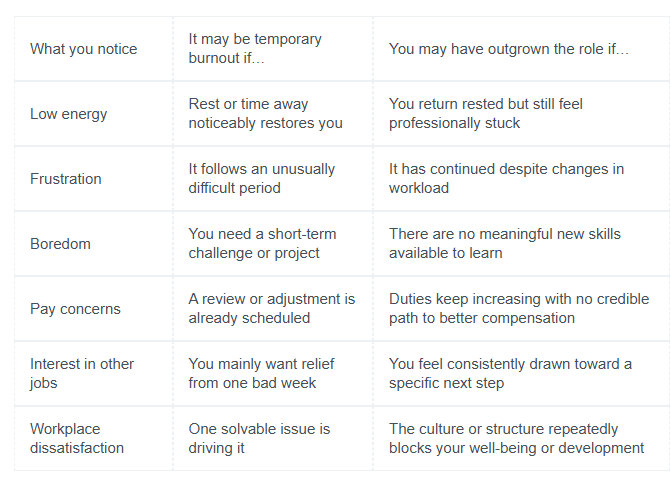
You may be experiencing both. A technician can be burned out because they have remained too long in a position with no growth, recognition, or support.
Before making a major decision during an especially emotional shift, give yourself enough space to identify the pattern. Review the last six to twelve months rather than only the last six to twelve hours.
What to Do Before Leaving Your Pharmacy Technician Job
Realizing that you may have outgrown your pharmacy technician job does not require an immediate resignation. A strategic transition protects your income, reputation, and long-term goals.
Once you believe you have outgrown your pharmacy technician job, the next step is to build a plan based on evidence rather than frustration.
1. Define What Must Change
Write down the three most important improvements you need from your next role. Examples might include higher pay, a predictable schedule, better management, remote work, less customer-facing responsibility, more clinical involvement, or a defined advancement path.
Separate necessities from preferences. This helps prevent you from leaving one frustrating job for another job with the same core problems.
2. Audit Your Experience
Create a list of the tasks, systems, medications, workflows, and special projects you know. Include unofficial responsibilities, such as training coworkers or resolving escalated problems. Long-term technicians often underestimate their expertise because familiar skills no longer feel impressive to them.
3. Compare Job Descriptions
Review at least ten positions that genuinely interest you. Track the qualifications that appear repeatedly. You may find that you already meet most requirements or that one targeted credential could make you more competitive.
4. Close Specific Skill Gaps
Do not collect credentials without a purpose. Choose education that connects directly to your intended role. Depending on your goal, that could involve national certification, state registration, sterile compounding training, specialty knowledge, leadership experience, technology skills, or continuing education.
The Pharm Techs Only! free CEU listings can help you find current educational opportunities while you plan your next move.
5. Update Your Résumé With Results
Replace basic duty statements with evidence of responsibility and impact. Instead of writing “trained employees,” specify how many people you trained and what the training covered. Instead of “managed inventory,” describe the scale, process, or improvement when you can do so accurately.
6. Build Connections Before You Need Them
Talk with technicians already doing the work that interests you. Ask what their typical day looks like, which qualifications mattered, and what they wish they knew before entering the setting.
You can connect with other pharmacy technicians, exchange experiences, and grow your professional network through TechConnect.
7. Leave Professionally
When possible, secure your next position before resigning. Review your employer’s notice requirements, benefit dates, paid-time-off policies, and any agreements you signed. Keep your resignation brief and professional and avoid using your final days to settle every old workplace grievance.
You are leaving to move your career forward, not to win one last argument.
Your Career Is Allowed to Grow
There is no universal number of years after which a pharmacy technician should change jobs. Some technicians find long-term growth, respect, and fulfillment with one employer. Others build successful careers by moving across settings and specialties.
The most important question is not, “Have I stayed too long?” It is, “Does this role still support the person and professional I am becoming?”
If you are learning, fairly compensated, respected, supported, and moving toward goals that matter to you, staying may be the right decision. If your skills have expanded while your opportunities have remained frozen, it may be time to explore.
You do not have to stop being a pharmacy technician to stop accepting a position you have outgrown. Your next step might be a new employer, a specialty, a certification, a leadership role, a remote position, or a career path you have not discovered yet.
Take inventory of what you know. Decide what you want to learn next. Then begin moving deliberately toward work that recognizes the value you now bring.
Having outgrown your pharmacy technician job is not a failure. It is often proof that your knowledge, goals, and professional value have continued to develop.
Join the conversation: Have you ever realized that you had outgrown a pharmacy technician job? What was the sign that finally convinced you it was time to make a change? Share your experience in the comments or connect with other technicians inside TechConnect.
Pharm Tech Important Link Bank:
Here are a few helpful resources to support your pharmacy technician career:
🔗 Free CEUs for Pharmacy Technicians
https://www.pharmtechsonly.com/resource-center/free-ceus/
🔗 Search Upcoming Conventions in Your Area
https://www.pharmtechsonly.com/resource-center/conventions/
🔗 Rx Study Buddy Kit (Top 200, Math, Law)
https://www.pharmtechsonly.com/store/
🔗 Search Pharmacy Technician Jobs
https://tc.pharmtechsonly.com/careers
FAQs
How do I know if I have outgrown my pharmacy technician job?
You may have outgrown your pharmacy technician job if you are no longer learning, your responsibilities have increased without better pay or recognition, there is no realistic advancement path, or your strongest skills are consistently underused. Look for a pattern lasting several months rather than judging the position by one difficult shift.
Does wanting a new job mean I chose the wrong career?
No. You may still enjoy pharmacy but need a different employer, setting, schedule, specialty, or level of responsibility. Retail, hospital, long-term care, specialty, compounding, mail-order, remote, insurance, informatics, and other pharmacy-related positions can offer very different experiences.
Should I quit if I feel burned out as a pharmacy technician?
Not necessarily. First consider whether rest, schedule changes, better staffing, clearer boundaries, or a conversation with management could improve the situation. If the underlying problems are persistent, harmful, or unlikely to change, developing a thoughtful exit plan may be appropriate.
What pharmacy technician jobs offer career growth?
Opportunities vary by location and employer, but potential paths include senior or lead technician roles, sterile compounding, specialty pharmacy, medication reconciliation, purchasing, inventory control, training, supervision, pharmacy informatics, prior authorization, quality assurance, auditing, and compliance support.
How can I prepare for a better pharmacy technician position?
Identify the role you want, compare several job descriptions, document your transferable skills, update your résumé, close only the skill gaps that matter, and connect with technicians working in your target area. Confirm all licensing, registration, certification, and training requirements for your location.
Is it bad to leave a pharmacy technician job after many years?
No. Long tenure can demonstrate reliability, depth of experience, and resilience. Present the move positively: explain that you are seeking growth, specialization, a new challenge, or stronger alignment with your long-term goals. Focus on what you are moving toward rather than criticizing what you are leaving.
Can I explore other jobs without telling my employer?
In most situations, technicians can privately research positions, update their résumé, network, and apply while still employed. Protect patient and employer information, conduct your search on personal time and personal devices, and review any applicable workplace agreements or policies.
Advance Your Pharmacy Technician Career
Access 100% free accredited CEUs, salary benchmarks, and connect with 26,000+ peers.
Faruq Niniola
Founder & AdvocateCourtney has over 30 years of frontline experience as a certified pharmacy technician across retail, hospital, and leadership settings. She founded Pharm Techs Only! to empower, elevate, and support pharmacy technicians worldwide.
Learn more about our mission →