 Faruq Niniola•August 19th, 2026•16 minute read
Table of Contents
- Start Your PTCE Prep Today!
- What Does Pharmacy Workplace Bullying Look Like?
- Is It Bullying, Workplace Conflict, or Legitimate Feedback?
- Why Pharmacy Workplace Bullying Can Be Difficult to Recognize
- How Workplace Bullying Affects Pharmacy Technicians
- What to Do If You Are Being Bullied at Work
- How to Document Pharmacy Workplace Bullying Effectively
- When Should You Report the Behavior?
- What If Management or Human Resources Does Nothing?
- When Leaving May Be the Healthiest Decision
- How Coworkers Can Help Stop Pharmacy Bullying
- You Deserve a Workplace Where Questions Are Safe
- FAQs
Pharmacy workplace bullying can make a technician question everything: their competence, their memory, their personality, and even whether they belong in pharmacy at all. It may be obvious, such as yelling or humiliation in front of patients. But it can also be quiet and calculated, being excluded from important communication, denied training, blamed for problems caused by poor staffing, or repeatedly assigned impossible workloads and then criticized for falling behind.
A difficult shift, a blunt coworker, or occasional corrective feedback does not automatically equal bullying. Pharmacy is fast-paced, highly regulated, and emotionally demanding. People become stressed, communication can be imperfect, and legitimate performance concerns must sometimes be addressed directly. The difference is usually the pattern, purpose, and power dynamic.
Pharmacy workplace bullying is repeated behavior that intimidates, humiliates, undermines, isolates, or unfairly targets someone. It can come from a manager, pharmacist, lead technician, coworker, or even a group. Regardless of who is responsible, the effects can follow a pharmacy technician long after the shift ends.
If you dread walking into work, constantly feel as if you are being set up to fail, or have started doubting abilities you once trusted, it is worth taking a closer look. This guide will help you recognize pharmacy workplace bullying, distinguish it from ordinary workplace conflict, document what is happening, respond strategically, and decide what to do next.
Featured Partner: Achievable PTCE Prep

Studying for your PTCE? Achievable's interactive online PTCE course makes complex topics simple, so you can pass the PTCB exam on your first attempt.
What's included:
Complete online textbook: Written in plain English, mobile-friendly, no dense textbook language.
600+ chapter quiz questions: Drill the key facts for every section.
4+ full-length practice exams: Weighted to match the official PTCB exam rubric.
Adaptive study planner: A personalized, day-by-day plan that keeps you on track for exam day.
AI tutor built in: Stuck on a medication name or safety regulation? Ask Achievable AI for instant answers with pharmacy-based examples.
Memory science that works: New material is followed by review quizzes, so what you learn actually sticks.
$99 one-time payment for a full year of access - no tiers to compare, no guessing if a few months will be enough. And it's backed by a pass guarantee: pass, or your money back.
Start Your PTCE Prep Today!
What Does Pharmacy Workplace Bullying Look Like?
Pharmacy workplace bullying is not limited to screaming, insults, or threats. Some of the most damaging behavior is subtle enough that each incident can be dismissed when viewed alone. The pattern becomes clear only after the incidents are considered together.
Public humiliation and constant criticism
This may include correcting a technician harshly in front of patients, laughing at their questions, making sarcastic comments about their intelligence, or repeatedly pointing out minor errors while ignoring the same mistakes made by others.
Constructive correction focuses on the task and explains how to improve it. Humiliation attacks the person. Statements such as “You need to verify the date before processing this claim” address a specific issue. Comments such as “How do you still not know this?” are meant to embarrass rather than teach.
Withholding information or training
A technician cannot succeed without access to accurate procedures and adequate training. Bullying may involve intentionally failing to share workflow changes, refusing to answer reasonable questions, teaching everyone except the targeted employee, or criticizing someone for not knowing a process they were never shown.
This creates a cycle: information is withheld, the technician makes a predictable mistake, and the mistake is then used as proof that the technician is incapable.
Setting someone up to fail
This can include assigning an unrealistic workload, providing contradictory instructions, changing expectations without warning, or giving a technician responsibility without the authority or resources necessary to complete it.
Pharmacy workloads can be demanding for everyone. The warning sign is selective and repeated treatment, for example, one technician consistently receives the busiest station without support and is then blamed for wait times, while others receive help.
Exclusion and social isolation
Not every coworker must be a friend. However, deliberately excluding one person from essential work communication, team discussions, training opportunities, group messages, or schedule updates can interfere with their ability to perform.
Social exclusion may also involve coworkers going silent when the person enters the room, organizing group complaints about them, spreading rumors, or encouraging new employees to avoid them.
Intimidation and threats
Threats are not always explicit. A manager might repeatedly remind a technician that they are replaceable, suggest that asking questions will affect their hours, or imply that speaking up will damage future references. A lead may use an aggressive tone, invade personal space, slam objects, or create fear without making a direct threat.
Unfair scheduling or assignment patterns
Scheduling is a legitimate management function, and undesirable shifts are sometimes unavoidable. It becomes concerning when schedule changes, reduced hours, denied requests, or punitive assignments appear to follow complaints, disagreements, or attempts to set boundaries.
Examples may include repeatedly assigning one technician every closing shift, changing only that person’s schedule with little notice, denying breaks that others receive, or reducing hours shortly after the technician reports a concern.
Sabotage and blame shifting
Sabotage may involve moving or hiding work, giving inaccurate directions, altering shared information, failing to communicate a problem, or blaming the targeted technician for another person’s mistake.
In a pharmacy, where records, timing, inventory, prescriptions, and patient safety matter, sabotage is especially serious. Any action that could affect a patient or the integrity of pharmacy records should be escalated promptly through the appropriate safety and compliance channels.
Is It Bullying, Workplace Conflict, or Legitimate Feedback?
It is important to distinguish pharmacy workplace bullying from an ordinary disagreement or appropriate coaching. Not every uncomfortable interaction is abusive, and labeling every correction as bullying can make it harder to address truly harmful conduct.
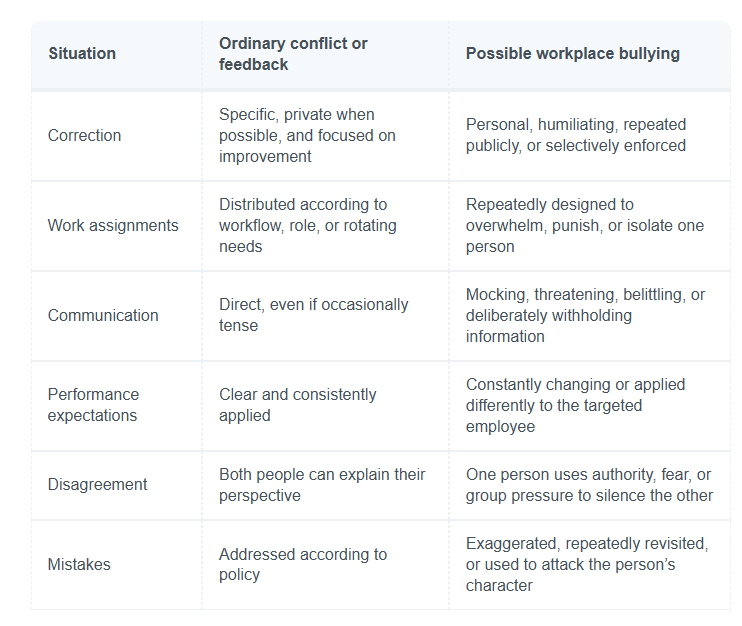
Ask yourself:
Is this behavior repeated rather than isolated?
Is one person being treated differently from comparable coworkers?
Does the behavior interfere with the person’s ability to do the job?
Is the goal correction and safety or embarrassment and control?
Is there a power imbalance that makes it difficult to respond?
Does the behavior continue after the concern has been communicated?
One incident can still be serious, particularly if it involves discrimination, harassment, threats, violence, record tampering, or patient safety. But repeated patterns are often what distinguish workplace bullying from a single bad interaction.
Why Pharmacy Workplace Bullying Can Be Difficult to Recognize
Pharmacy technicians often work in environments where urgency and stress are treated as normal. Phones are ringing, patients are waiting, prescriptions are accumulating, staffing may be inadequate, and accuracy cannot be sacrificed. In that setting, pharmacy workplace bullying can be excused as “just how pharmacy is.”
Some technicians are also taught that they must develop a thick skin, avoid questioning authority, and prove themselves by handling whatever is assigned. New technicians may assume humiliation is part of training. Experienced technicians may remain silent because they have survived similar treatment or fear becoming the next target.
Pharmacy workplace bullying also tends to happen through plausible deniability. The person responsible may behave professionally around upper management but differently when no one with authority is present. Individual incidents may sound minor when reported separately:
“She forgot to tell me about the change.”
“He was only joking.”
“They were stressed.”
“My hours happened to be reduced.”
“I misunderstood the assignment.”
That is why documenting the pattern, not merely describing how it felt is so important.
How Workplace Bullying Affects Pharmacy Technicians
Pharmacy workplace bullying is not simply a personality clash. Over time, it can affect job performance, physical health, emotional well-being, and patient safety.
A targeted technician may begin double- and triple-checking routine work because they no longer trust their judgment. They may stop asking questions to avoid ridicule, even when clarification is necessary. Concentration can become more difficult, and the fear of making a mistake may actually increase the likelihood of one.
Common effects include:
Anxiety before scheduled shifts
Trouble sleeping or replaying interactions after work
Headaches, stomach discomfort, muscle tension, or exhaustion
Reduced confidence and increased self-doubt
Fear of asking questions or reporting errors
Withdrawal from coworkers and professional opportunities
Calling out more often or considering leaving pharmacy entirely
Burnout, depression, or a constant sense of being on alert
The pharmacy may also experience higher turnover, poorer communication, decreased reporting of near misses, and reduced teamwork. A culture in which employees are afraid to speak is not a strong safety culture.
What to Do If You Are Being Bullied at Work
There is no single response to pharmacy workplace bullying that is safe or appropriate in every workplace. Your strategy may depend on who is involved, how serious the behavior is, whether patient safety is affected, and whether leadership can be trusted to respond fairly.
1. Pause and identify the pattern
Before confronting anyone, write down the specific behavior. Replace general conclusions such as “My manager hates me” with observable facts: “On August 12, my manager criticized me by name in front of three patients and said I was too slow to work in pharmacy.”
Concrete examples will help you evaluate the situation more clearly and communicate it more effectively.
2. Check policies and reporting channels
Review the employee handbook, workplace conduct policy, anti-harassment policy, ethics hotline information, union agreement if applicable, and the company’s complaint process. Determine whether concerns should go to the pharmacy manager, store or facility leadership, human resources, compliance, or another designated department.
Do not assume every company uses the same reporting structure.
3. Set a direct boundary when it is safe
Some behavior can be addressed early with a short, calm response. Avoid a long argument in the middle of a busy shift.
Possible statements include:
“Please speak to me privately if you have a concern about my work.”
“I’m willing to discuss the mistake, but I need the conversation to remain professional.”
“I want to complete this correctly. Which instruction should I follow?”
“That comment was not appropriate. Please do not speak to me that way.”
“I was not trained on that process. Please show me the correct procedure or direct me to the written policy.”
If the person has threatened you, acted violently, retaliated previously, or controls your employment in a way that makes confrontation unsafe, skip the direct conversation and use a formal reporting channel.
4. Keep communication factual
When emotions are understandably high, it can be tempting to describe the person as toxic, jealous, narcissistic, or evil. Those labels are difficult to prove and can distract from the conduct.
Focus on what happened, when it happened, who witnessed it, how it affected the work, and what resolution you are requesting.
5. Identify a reasonable outcome
Do you want the behavior investigated? A reporting relationship changed? Written procedures provided? Training offered? A schedule decision reviewed? Communication handled privately? Knowing what you are asking for makes the report more actionable.
How to Document Pharmacy Workplace Bullying Effectively
Good documentation of pharmacy workplace bullying is specific, chronological, and factual. Create a private log that includes:
Date and approximate time
Location or work area
Names of the people involved
Exact words or actions, as closely as you can recall them
Names of witnesses
The work-related impact
Your response
Whether and to whom you reported it
Any action taken afterward
For example:
August 14, approximately 3:20 p.m., drop-off station. The lead technician told me, “Everyone else understands this except you,” within hearing distance of two coworkers and several patients. I asked to discuss the issue privately. The lead refused and continued criticizing my speed. Coworker A and Coworker B were present. I reported the interaction to the pharmacy manager at approximately 5:00 p.m.
Preserve relevant schedules, written instructions, performance reviews, messages, or emails when permitted. Never remove confidential patient information, prescription records, proprietary company information, or documents you are not authorized to possess. Do not secretly record conversations unless you have confirmed that doing so is lawful and permitted where you work.
The goal is not to build a dramatic story. It is to create an accurate record showing the frequency, consistency, and work-related consequences of the behavior.
When Should You Report the Behavior?
Consider reporting pharmacy workplace bullying when the behavior is repeated, affects your ability to work, involves retaliation, creates safety concerns, or continues after you have attempted to set a reasonable boundary.
Report immediately through the appropriate emergency, safety, compliance, or leadership channel if the situation involves:
Threats of physical harm or actual violence
Discrimination or harassment connected to a legally protected characteristic
Sexual harassment
Retaliation for reporting a safety, legal, or compliance concern
Prescription or record tampering
Diversion concerns
Conduct that creates an immediate risk to patients
When making a report, organize your strongest examples rather than presenting every unpleasant interaction at once. Explain the pattern and its impact on work.
A clear opening might be:
I am reporting a repeated pattern of conduct that is interfering with my ability to perform my job. I have documented several specific incidents involving public humiliation, withheld work information, and inconsistent instructions. I would like the behavior reviewed and expectations for professional communication clarified.
Keep a record of when the report was made, what information was provided, who received it, and any next steps discussed.
What If Management or Human Resources Does Nothing?
Reporting pharmacy workplace bullying does not guarantee a fair or immediate resolution. The company may investigate quietly, disagree with your interpretation, take action it cannot disclose, or fail to respond adequately.
If nothing changes:
Follow up in writing and reference the original report date.
Add new incidents to your documentation.
Use the next appropriate reporting level listed in company policy.
Contact a union representative if you are represented.
Consider an employment attorney or appropriate government agency if the conduct may involve unlawful harassment, discrimination, retaliation, wage issues, or another legal violation.
Protect your health and begin exploring other employment if the environment remains harmful.
General bullying is not necessarily illegal by itself, and employment laws vary by location. A qualified professional can help you understand whether the conduct crosses a legal boundary. This article provides general workplace information, not legal advice.
When Leaving May Be the Healthiest Decision
Leaving should not be presented as the only solution, especially when someone needs income, health coverage, scheduling flexibility, or experience. The person being targeted should not have to surrender a job because someone else behaved badly.
However, there are situations in which protecting your health and professional future may become more important than convincing an unhealthy workplace to change.
It may be time to plan an exit when:
The behavior continues or worsens after being reported.
Management participates in or protects the conduct.
You experience retaliation for speaking up.
You are pressured to compromise patient safety or professional standards.
Your physical or mental health is significantly deteriorating.
You no longer feel safe asking necessary questions.
The workplace has convinced you that mistreatment is normal and unavoidable.
If possible, leave strategically. Update your résumé, gather appropriate references, document your accomplishments, review benefits and finances, and begin applying before resigning. Avoid criticizing the workplace during interviews. A concise explanation such as “I’m looking for a more collaborative environment with clear training and communication” keeps the focus on what you want next.
Most importantly, do not let one toxic pharmacy convince you that every pharmacy will be the same. Workplace cultures can differ enormously, even between locations within the same company.
How Coworkers Can Help Stop Pharmacy Bullying
Pharmacy workplace bullying often continues because witnesses stay silent. They may fear retaliation, believe it is not their business, or feel relieved that they are not the target. Silence, however, can unintentionally signal that the behavior is acceptable.
Coworkers can help by:
Refusing to laugh at humiliating comments
Redirecting the conversation to the work issue
Sharing necessary information instead of participating in exclusion
Checking on the targeted employee privately
Offering an accurate witness statement when asked
Reporting serious safety, harassment, or retaliation concerns
Modeling respectful correction and communication
A simple statement, “We can correct the issue without speaking to her that way”, can interrupt the behavior and show the targeted technician that they are not imagining what happened.
You Deserve a Workplace Where Questions Are Safe
Pharmacy technicians are expected to protect accuracy, communicate clearly, solve problems, support patients, and adapt constantly. They cannot do their best work in an environment built on fear and humiliation.
Professional accountability and respectful treatment can exist at the same time. Technicians should be corrected when necessary, but correction should be specific, consistent, and focused on safe improvement. Training should prepare people to succeed, not be withheld and later used against them.
If something at work feels wrong, look for the pattern. Write down the facts. Learn the available reporting options. Set boundaries when it is safe, seek support, and make decisions that protect both your professional standards and your well-being.
Being targeted does not mean you are weak, incapable, or unsuited for pharmacy. Sometimes the problem is not your ability to handle the workplace. Sometimes the workplace has failed to handle its people responsibly.
Pharm Tech Important Link Bank:
Here are a few helpful resources to support your pharmacy technician career:
🔗 Free CEUs for Pharmacy Technicians
https://www.pharmtechsonly.com/resource-center/free-ceus/
🔗 Search Upcoming Conventions in Your Area
https://www.pharmtechsonly.com/resource-center/conventions/
🔗 Rx Study Buddy Kit (Top 200, Math, Law)
https://www.pharmtechsonly.com/store/
🔗 Search Pharmacy Technician Jobs
https://tc.pharmtechsonly.com/careers
FAQs
What is considered workplace bullying in a pharmacy?
Pharmacy workplace bullying is repeated conduct that intimidates, humiliates, isolates, undermines, or unfairly targets an employee. Examples include public ridicule, withheld training, sabotage, threats, exclusion from essential communication, impossible assignments, blame shifting, and retaliatory scheduling.
Is a pharmacist correcting a technician considered bullying?
Not necessarily. Pharmacists and managers are responsible for addressing mistakes, performance, workflow, and patient safety. Appropriate feedback is specific, professional, and focused on improvement. Correction may become bullying when it is repeatedly humiliating, personal, threatening, selectively enforced, or intended to undermine the technician rather than correct the work.
How should a pharmacy technician document bullying?
Keep a private chronological log with dates, approximate times, locations, exact words or actions, witnesses, work-related effects, your response, and any reports made. Preserve relevant nonconfidential messages or schedules when permitted, but never remove patient information or records you are not authorized to possess.
Should I confront the coworker who is bullying me?
A short, direct boundary may help when the situation is safe and the behavior is not threatening. If there is violence, intimidation, previous retaliation, or a significant power imbalance, use an appropriate manager, human resources, ethics, compliance, union, or safety channel instead of confronting the person alone.
Can I be fired for reporting workplace bullying?
Employment protections depend on the location, the conduct reported, and other circumstances. Reports involving discrimination, harassment, safety, wage issues, or other protected activity may carry legal protections, but general workplace bullying is not treated identically everywhere. Review company policy and seek qualified legal or agency guidance for your situation.
What if the pharmacy manager is the bully?
Review the reporting structure for the next level of leadership, human resources, employee relations, ethics, compliance, or a union representative. Use specific documented examples and explain how the conduct affects your work or patient safety. Do not route the complaint back through the manager if the policy provides a direct alternative.
Is it better to report bullying or find another job?
That depends on the seriousness of the conduct, the reliability of the reporting process, your financial situation, your health, and whether you feel safe. Reporting may help stop the behavior, but preparing an exit is reasonable when management protects the conduct, retaliation occurs, or the environment is harming your health or professional integrity.
Can workplace bullying affect patient safety?
Yes. Employees who fear ridicule or retaliation may avoid asking questions, reporting near misses, clarifying unclear directions, or speaking up about risks. A respectful pharmacy culture supports open communication, learning, and safer patient care.
Advance Your Pharmacy Technician Career
Access 100% free accredited CEUs, salary benchmarks, and connect with 26,000+ peers.
Faruq Niniola
Founder & AdvocateCourtney has over 30 years of frontline experience as a certified pharmacy technician across retail, hospital, and leadership settings. She founded Pharm Techs Only! to empower, elevate, and support pharmacy technicians worldwide.
Learn more about our mission →